NASA
Jet Propulsion Laboratory California Institute of Technology
Skip Navigation
AIRS
Stay Connected
menu close modal
Multimedia

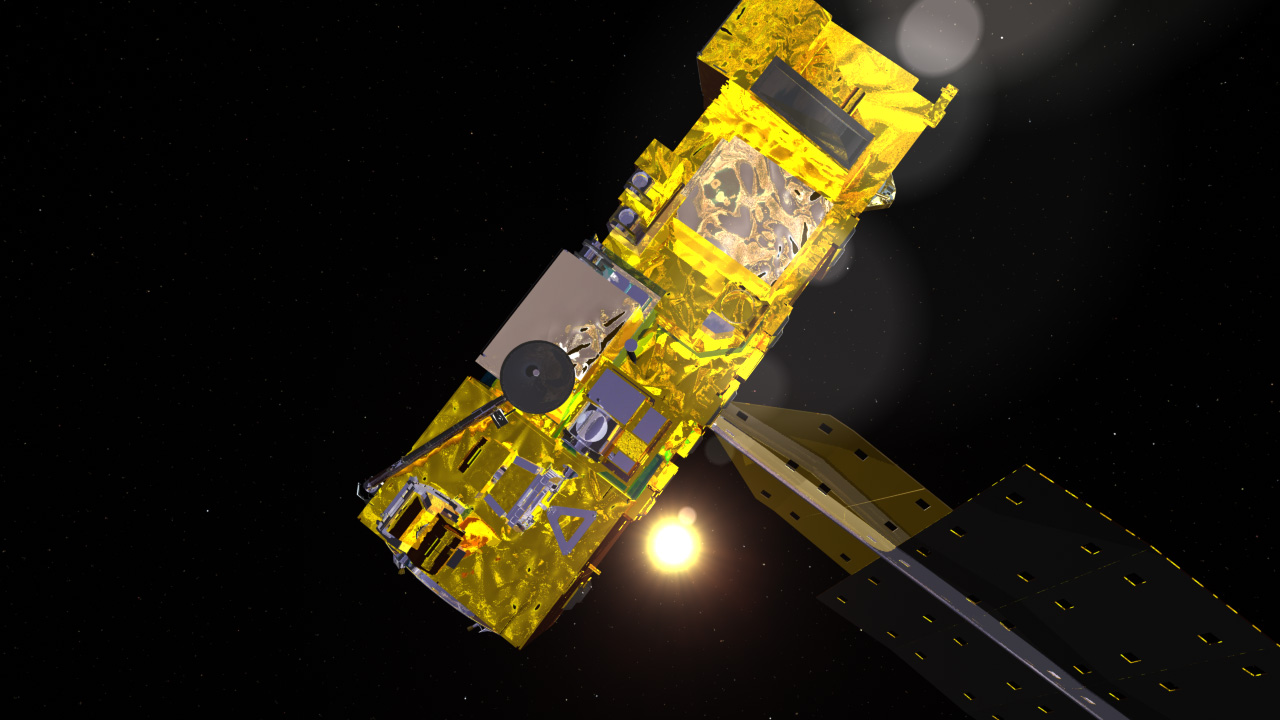
NASA's Aqua satellite

NASA's Aqua satellite
Source: NASA
Published: July 8, 2019

Artist's concept of NASA's Aqua satellite launched May 4, 2002.

ENLARGE

Downloads

214 KB
image/jpeg
Download

More Like This

  • Images
  • AIRS and AQUA

Related

AIRS, AMSU, HSB on NASA's Aqua satellite
More
AIRS, AMSU, HSB on NASA's Aqua satellite
This image represents the total precipitable water vapor for May, 2009 as observed by AIRS, the Atmospheric Infrared Sounder (AIRS) on NASA's Aqua satellite.
More
Global Total Precipitable Water Vapor for May 2009
AIRS radiances and standard retrievals were used to obtain thin cirrus particle size and optical depth over the tropical oceans.
More
Tropical thin cirrus retrievals of particle size and optical depth from AIRS
This image shows average temperatures in April, 2003, observed by AIRS at an infrared wavelength that senses either the Earth's surface or any intervening cloud. 
More
Global Average Brightness Temperature for April 2003
These images show the joint distributions of cloud top temperature, particle size, and optical depth with relative humidity with respect to ice (RHic), all of which are calculated from AIRS.
More
Joint distributions of thin cirrus properties and relative humidity from AIRS-7
Both images in the slide show the global spreading of carbon dioxide on the Earth globe as it follows the large scale patterns of the atmospheric general circulations.
More
Mid-Tropospheric Carbon Dioxide at 8-13 km Altitudes, July 2003 and July 2007
Infrared image of Hurricane Beryl, close to the time of landfall near Houston, Texas, in the early morning of July 8, 2024
More
In the infrared image of Hurricane Beryl, close to the time of landfall near Houston, Texas, in the early morning of July 8, 2024, the large purple areas indicate very cold clouds carried high into the atmosphere by deep thunderstorms and associated with heavy rainfall. Warmer areas with shallower rain clouds are shown in blue and green. The orange and red areas represent mostly cloud-free air.
AIRS Views Hurricane Beryl over Texas Coast
NASA's Aqua satellite in high bay
More
NASA's Aqua satellite in high bay
NASA’s latest Earth Observing System (EOS) satellite — Aqua — successfully launched Saturday morning, May 4, 2002.
More
Artist's rendering of NASA's Aqua Satellite Orbiting Earth
This map created with data from the Atmospheric Infrared Sounder (AIRS) on NASA's Aqua satellite shows the concentration of carbon dioxide in Earth's mid-troposphere, located roughly between 3 to 6...
More
Carbon Dioxide in Earth's Mid-Troposphere, April 2013 Monthly Average
The Atmospheric Infrared Sounder (AIRS) instrument in the assembly facility, 1999. 
More
AIRS instrument
AIRS instrument
NASA's Aqua satellite in high bay
More
NASA's Aqua satellite in high bay
NASA's Earth observing satellite, Aqua, successfully launched at 2:55 a.m. PDT on ay 4, 2002.
More

NASA Aqua Satellite Launch
In late July 2010, flooding caused by heavy monsoon rains began in several regions of Pakistan, including the Khyber Pakhtunkhwa, Sindh, Punjab and parts of Baluchistan.
More
Extent of Pakistan Flooding
This image is the AIRS-retrieved global tropospheric methane for August 2005.
More
Global Tropospheric Methane for August 2005
This image was created with data acquired by the Atmospheric Infrared Sounder instrument (AIRS) on NASA's Aqua satellite during July 2009.
More
Global Carbon Dioxide Transport from AIRS Data, July 2009
Although originally designed to measure atmospheric water vapor and temperature profiles for weather forecasting, data from the Atmospheric Infrared Sounder (AIRS) instrument on NASA's Aqua spacecr...
More
Global Carbon Dioxide, July 2003
This image shows a detection of sulfur dioxide in AIRS data taken about two days after the Tonga volcano eruptions in January 2022. 
More
This image shows a detection of sulfur dioxide in AIRS data taken about two days after the Tonga volcano eruptions in January 2022.
Sulfur Dioxide Detected After Tonga Volcano Eruption in 2022
This image shows Hurricane Frances as captured by instruments onboard two different satellites: the AIRS infrared instrument onboard Aqua, and the SeaWinds scatterometer onboard QuikSCAT.
More
Hurricane Frances as Observed by AIRS and SeaWinds, August 2004
On July 12, 2008, Okmok Volcano, in Alaska’s Aleutian Islands erupted, releasing a plume of ash and steam.
More
Sulfur Dioxide from Okmok Volcano, July 2008
This plot shows the concentration of carbon dioxide in Earth's mid-troposphere at various latitudes as measured by the Atmospheric Infrared Sounder (AIRS) instrument on NASA's Aqua satellite.
More
Zonally Averaged Carbon Dioxide Concentration from Earth's Mid-Troposphere at Different Latitudes, 2002 to 2013
NASA's Earth observing satellite, Aqua, successfully launched at 2:55 a.m. PDT on ay 4, 2002.
More
NASA Aqua Satellite Launch
The Atmospheric Infrared Sounder (AIRS) instrument in the assembly facility, 1999. 
More
AIRS instrument
AIRS instrument
These sub-panels show differences in the characteristics of RHic histograms within thin cirrus clouds for different regions and time periods.
More
Relative humidity distributions within thin cirrus for several regions and inter-annual variations in the Indian Ocean
This graph made with data from the Atmospheric Infrared Sounder on NASA's Aqua satellite shows the concentration of carbon dioxide in Earth's mid-troposphere, located roughly between 3 to 6 miles (...
More
Concentration of Atmospheric Carbon Dioxide from Earth's Mid-Troposphere, 2002 to 2013
more resources

News & Features

Satellite imagery from AIRS captures sulfur dioxide plumes from Hayli Gubbi volcanic eruption in Ethiopia propagating across Asia.
More
AIRS Tracks Plumes from Ethiopian Volcano Across Asia
The figure shows the impact of the annual mean increase of CO2 on different ‘colors’ (wavenumbers) of infrared radiation emitted by the Earth’s atmosphere from theory (in red) and measured by the AIRS instrument (in blue)
More
Confirming a Critical Foundation of the Science of Global Warming
Infrared image of Hurricane Helene after landfall in Florida
More
NASA's AIRS Instrument Captures Hurricane Helene
AIRS image showing Hurricane Hilary off the coast of Mexico in brightness temperature at infrared wavelenghts
More
Hurricane Hilary Captured by NASA's AIRS
Cold California weather after polar vortex breakdown captured by AIRS
More
February Cold in California as Captured by AIRS
Atmospheric River Storms hitting the US West Coast shown with AIRS brightness temperature data
More
California Atmospheric River Storms Captured by NASA's AIRS
All News

Stay Connected

Home

Sounding Science

    • Overview
    • What is Sounding?
    • Weather
    • Climate
    • Composition
    • Significant Findings
    • Publications
    • Sounding Science at JPL

Mission

    • Overview
    • Science Objectives
    • AIRS Project Instrument Suite
    • Instrument Operations
    • Instrument Calibration
    • People

Data

    • About the Data
    • About the Products
    • Get Data
    • User Guides & Documentation
    • Validation
    • Outages
    • Readers & Tools
    • View Data
    • Support

Applications

    • Health
    • Volcano
    • Drought
    • Wildfire
    • Weather

Multimedia

Science Meetings

    • Science Team Meetings
    • Sounder Discipline Monthly Telecons
  • Feedback
  • |
  • Ask AIRS
  • |
  • Privacy
  • |
  • News

Site manager and webmaster: Heidar Thor Thrastarson