NASA
Jet Propulsion Laboratory California Institute of Technology
Skip Navigation
AIRS
Stay Connected
menu close modal
Multimedia

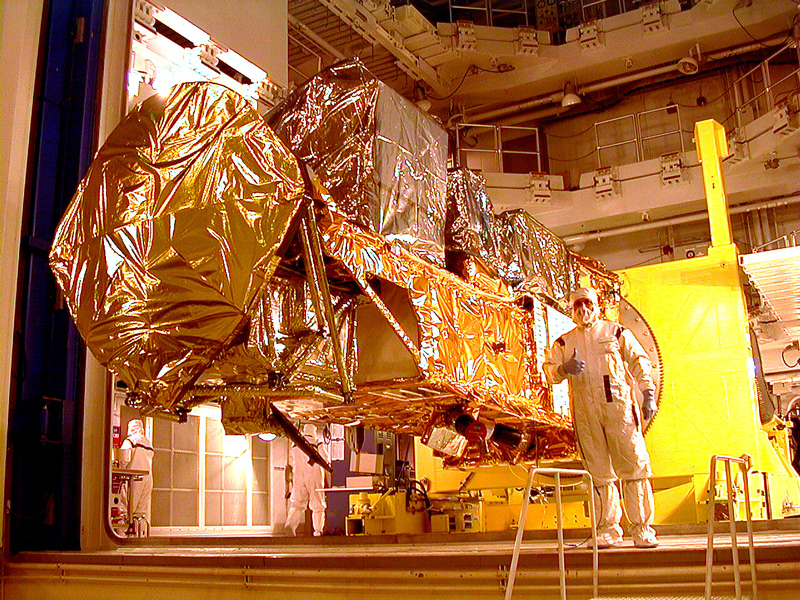
NASA's Aqua satellite in high bay

NASA's Aqua satellite in high bay
Source: NASA/JPL AIRS Project
Published: July 3, 2019

NASA's Aqua satellite in high bay

ENLARGE

Downloads

1.02 MB
image/jpeg
Download

More Like This

  • Images
  • AIRS and AQUA

Related

This image shows average temperatures in April, 2003, observed by AIRS at an infrared wavelength that senses either the Earth's surface or any intervening cloud. 
More
Global Average Brightness Temperature for April 2003
Mt. Etna, a volcano on the island of Sicily, erupted on October 26, 2002. 
More
Sulfur Dioxide Plume from Mt. Etna Eruption 2002
NASA's Earth observing satellite, Aqua, successfully launched at 2:55 a.m. PDT on ay 4, 2002.
More
NASA Aqua Satellite Launch
Shown here is the latest infrared image of Yasi from the Atmospheric Infrared Sounder (AIRS) instrument on NASA's Aqua satellite, built and managed by NASA's Jet Propulsion Laboratory, Pasadena, Ca...
More
Monster Cyclone Yasi Eyes Australia 2011
This image represents the total precipitable water vapor for May, 2009 as observed by AIRS, the Atmospheric Infrared Sounder (AIRS) on NASA's Aqua satellite.
More
Global Total Precipitable Water Vapor for May 2009
NASA’s Atmospheric Infrared Sounder (AIRS) captured a series of images of Hurricanes Idalia before landfall in Florida and as it crossed the Southeastern United States, including views of Hurricane...
More
A series of AIRS images of Hurricanes Idalia before landfall in Florida and as it crossed the Southeastern United States, including views of Hurricane Franklin in the Atlantic Ocean.
Hurricanes Idalia and Franklin as Viewed by AIRS
NASA’s Atmospheric Infrared Sounder (AIRS) captured views of Hurricane Ida, both before it made landfall in the early morning hours (2:53 CDT) and approximately two hours after the storm's landfall...
More
infrared image Hurricane Ida before making landfall
AIRS captures Hurricane Ida before and after landfall
AIRS' global carbon monoxide measurements are important because scientists can monitor the transport of fire emissions around the globe on a daily basis. 
More
Carbon Monoxide Blooms September 2005
Trends in the AIRS monthly temperature anomaly at 931 mb from 2003 to 2022 shown on a global map.  
More
Trends in the AIRS monthly temperature anomaly at 931 mb from 2003 to 2022 shown on a global map.
Global map of AIRS temperature trend from 2003 to 2022
Water vapor is the dominant greenhouse gas in our atmosphere. The greenhouse effect of water vapor is enhanced at high altitudes, where the air is significantly colder than the ground, and increase...
More
Mean Clear Air Precipitable Water, 500mb to top-of-atmosphere, January and July 2003
These false-color images show the amount of atmospheric water vapor observed by AIRS two weeks prior to the passage of Hurricane Isabel, and then when it was a Category 5 storm. 
More
Amount of Atmospheric Water Vapor in Hurricane Isabel as Observed By AIRS
Supertyphoon Pongsona over Guam, December 8, 2002. The image is a composite made by overlaying data from the infrared, microwave, and visible/near infrared sensors that make up the AIRS sounding sy...
More
Supertyphoon Pongsona over Guam, 2002
Widespread forest fires across Indonesia have burned tens of thousands of acres over three months, causing high levels of pollution, loss of life, and billions of dollars to the Indonesian governme...
More
Carbon Monoxide in Mid-Troposphere over Indonesia Fires, October 26-28, 2015
Global carbon monoxide measurements from NASA's Atmospheric Infrared Sounder are important because scientists can monitor the transport of fire emissions around the globe on a daily basis.
More
Global Carbon Monoxide, September 29, 2005
NASA's Earth observing satellite, Aqua, successfully launched at 2:55 a.m. PDT on ay 4, 2002.
More
NASA Aqua Satellite Launch
This image is the AIRS-retrieved global tropospheric methane for August 2005.
More
Global Tropospheric Methane for August 2005
Atmospheric Infrared Sounder instrument sections
More
Atmospheric Infrared Sounder instrument sections
NASA's Earth observing satellite, Aqua, successfully launched at 2:55 a.m. PDT on ay 4, 2002.
More

NASA Aqua Satellite Launch
The continuing heat wave in the United States in July 2011 has broken temperature records in many locations, killed dozens and seen nearly half of all Americans under heat advisories at its peak.
More
Evolution of U.S. 2011 Heat Wave
The plume of carbon monoxide pollution from the Rim Fire burning in and near Yosemite National Park, Calif., is visible in this Aug. 26, 2013 image from the Atmospheric Infrared Sounder (AIRS) inst...
More
AIRS Images Pollution from California's Rim Fire 2013
This graph made with data from the Atmospheric Infrared Sounder on NASA's Aqua satellite shows the concentration of carbon dioxide in Earth's mid-troposphere, located roughly between 3 to 6 miles (...
More
Concentration of Atmospheric Carbon Dioxide from Earth's Mid-Troposphere, 2002 to 2013
NASA's Aqua satellite in high bay, prepare to hoist
More
NASA's Aqua satellite in high bay, prepare to hoist
NASA's Aqua satellite in high bay
More
NASA's Aqua satellite in high bay
This image was created with data acquired by the Atmospheric Infrared Sounder instrument (AIRS) on NASA's Aqua satellite during July 2009.
More
Global Carbon Dioxide Transport from AIRS Data, July 2009
This image shows Hurricane Frances as captured by instruments onboard two different satellites: the AIRS infrared instrument onboard Aqua, and the SeaWinds scatterometer onboard QuikSCAT.
More
Hurricane Frances as Observed by AIRS and SeaWinds, August 2004
more resources

News & Features

Satellite imagery from AIRS captures sulfur dioxide plumes from Hayli Gubbi volcanic eruption in Ethiopia propagating across Asia.
More
AIRS Tracks Plumes from Ethiopian Volcano Across Asia
The figure shows the impact of the annual mean increase of CO2 on different ‘colors’ (wavenumbers) of infrared radiation emitted by the Earth’s atmosphere from theory (in red) and measured by the AIRS instrument (in blue)
More
Confirming a Critical Foundation of the Science of Global Warming
Infrared image of Hurricane Helene after landfall in Florida
More
NASA's AIRS Instrument Captures Hurricane Helene
AIRS image showing Hurricane Hilary off the coast of Mexico in brightness temperature at infrared wavelenghts
More
Hurricane Hilary Captured by NASA's AIRS
Cold California weather after polar vortex breakdown captured by AIRS
More
February Cold in California as Captured by AIRS
Atmospheric River Storms hitting the US West Coast shown with AIRS brightness temperature data
More
California Atmospheric River Storms Captured by NASA's AIRS
All News

Stay Connected

Home

Sounding Science

    • Overview
    • What is Sounding?
    • Weather
    • Climate
    • Composition
    • Significant Findings
    • Publications
    • Sounding Science at JPL

Mission

    • Overview
    • Science Objectives
    • AIRS Project Instrument Suite
    • Instrument Operations
    • Instrument Calibration
    • People

Data

    • About the Data
    • About the Products
    • Get Data
    • User Guides & Documentation
    • Validation
    • Outages
    • Readers & Tools
    • View Data
    • Support

Applications

    • Overview
    • Weather
    • Volcano
    • Drought
    • Wildfire
    • Health

Multimedia

Science Meetings

    • Science Team Meetings
    • Sounder Discipline Monthly Telecons
  • Feedback
  • |
  • Ask AIRS
  • |
  • Privacy
  • |
  • News

Site manager and webmaster: Heidar Thor Thrastarson